Fieldcraft systemWorking Content OS / interaction prototype

An AI chief of staff designed to narrow the work, not multiply it.

A documented focus and permission model connects to a working local operating layer for ideas, content, research, tasks, activity, and approvals.

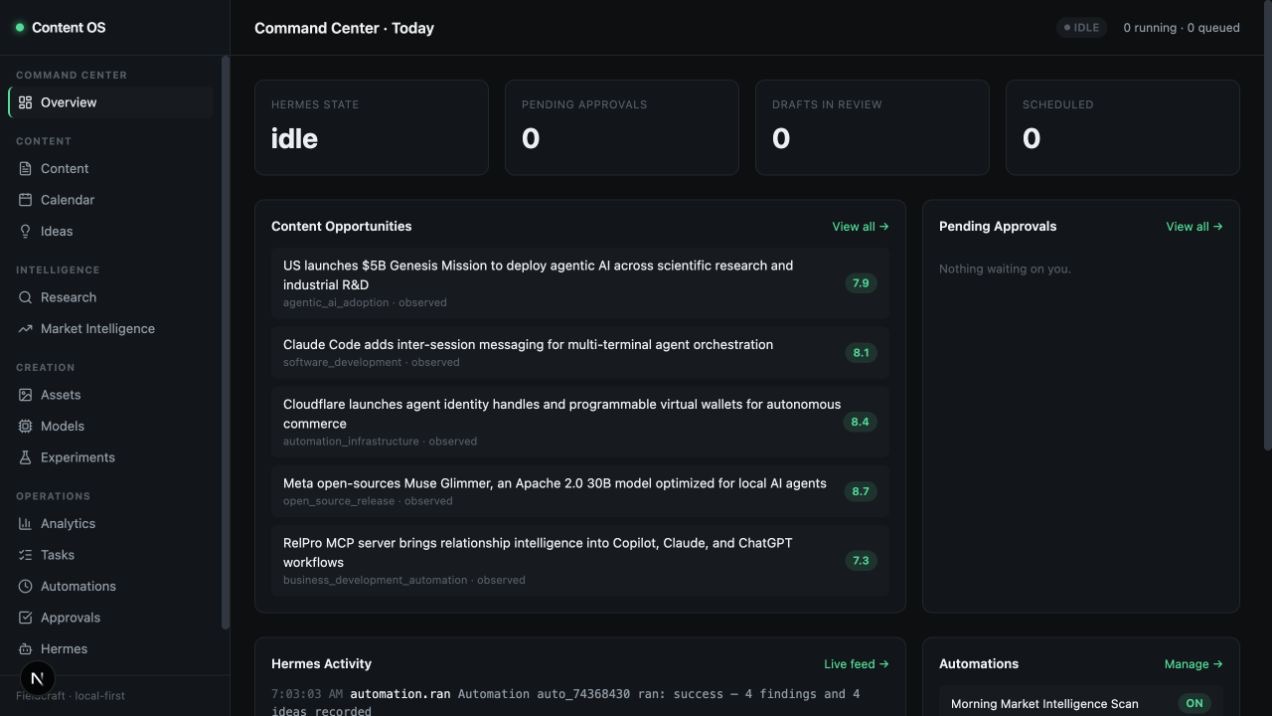
Griffin Content OS command centre showing evidence-labelled opportunities, pending approvals, task state, activity, and operating modules
The verified local Content OS makes operating state, evidence, activity, and approvals visible.Working local app

At a glance.

Operating layer
Internal Command Centres
User
Founder-operator
System boundary
Local Content OS and prototype interaction model
Current status
One working layer, one incomplete scaffold
Evidence type
Runtime, source, and design specifications

The operating problem.

Ideas, client context, research, priorities, tasks, and drafted work compete across separate systems. New activity can create more threads without helping the most important one finish.

Griffin is designed around convergence: preserve one active priority, triage new ideas, expose evidence and state, and ask before consequential action.

Before

Competing ideas and scattered operating state

Research, content, client context, tasks, and decisions pull attention into separate surfaces.

After

One governed model for focus and follow-through

Priority, evidence, work state, activity, and permission remain visible and interruptible.

Two connected layers.

The interaction prototype defines how Griffin should narrow the work. The Content OS provides the verified operating record beneath it.

Chief-of-staff layer

Briefing, conversation, current priority, idea triage, pushback, focus state, client context, and permission requests. This layer is documented in detailed design specifications, but its current app checkout is incomplete.

Content OS layer

Content, calendar, ideas, research, market intelligence, assets, models, experiments, analytics, tasks, automations, approvals, activity, and brand memory in a working local application.

How the interaction is designed.

This sequence describes the documented chief-of-staff model and shows where the working operating layer supports it.

  1. Open with one priorityA morning briefing narrows the day to the active thread and visible constraints.
  2. Capture without activatingA new idea enters the inbox instead of silently becoming new active work.
  3. Classify the ideaActive, parked, or killed states force a deliberate decision.
  4. Show the tradeoffA new request is compared with the current priority before scope expands.
  5. Inspect evidence and client contextResearch status, prior decisions, brand memory, and operating context remain attached.
  6. Review drafted workTasks and activity expose what was created, what failed, and what needs attention.
  7. Approve consequential actionAn approval record separates recommendation from publishing, sending, or spending.
  8. Close the loopCompleted, blocked, parked, and next-action states persist in the operating record.

How the working Content OS operates.

Evidence-aware operating flow

ResearchEvidence status
Market intelligenceWhat changed and why
IdeaPromoted deliberately
Content itemState and brief
TaskQueued through review
ActivityAppend-only record
ApprovalPending or decided
External actionConvention-gated

Approval is visible and required by the operating contract, but the current API does not technically prevent a direct write from bypassing it.

Important decisions.

Evidence status is first-class

Observed, inferred, recommended, and unverified labels keep certainty attached to research and decisions.

Task state is explicit

Queued, running, paused, waiting, review, completed, error, and cancelled states create a durable operating record.

Unavailable providers stay visible

Configured flags and provider stubs expose missing capability instead of faking a successful generation.

Approval is honest about its limit

The workflow requires approval, while the source documentation states that middleware enforcement remains deferred.

Evidence gallery.

The public capture comes from the running Content OS. The chief-of-staff layer is represented by its documented interaction model, not a fabricated screenshot.

Running Griffin Content OS overview with content opportunities, approvals, activity, and operations navigation
The command centre exposes evidence-labelled opportunities, pending approvals, Hermes activity, automations, and the complete operating navigation.Captured 8 September 2026

What Fieldcraft delivered.

Interaction architecture

A chief-of-staff model for briefing, one active thread, idea triage, pushback, client intelligence, conversation, and explicit permission states.

Operating application

A local Next.js and SQLite system for content, evidence, market intelligence, models, tasks, activity, automations, analytics, approvals, and brand memory.

Proof boundary.

Verified

  • The Content OS runs locally with SQLite-backed routes, task state, SSE activity, evidence labels, and approval records.
  • The chief-of-staff interaction model is specified across detailed design documents.
  • Provider and approval limitations are documented in source.

Not claimed

  • The Core Application checkout is not currently runnable because imported page and component files are missing.
  • Not every connector is live, and approval is not middleware-enforced.
  • No autonomous publishing, payments, outreach, internet-ready security, or production readiness is claimed.

Narrow the work

Map the internal bottleneck that keeps multiplying.

Connect priorities, evidence, tasks, decisions, and approvals in one visible operating model.

Map My Internal Operating Bottleneck