Lead qualification, built as a governed calling system.
A configurable blueprint connects campaign control, conversation state, qualification, outcomes, and operator review without hiding the work behind a voice API.
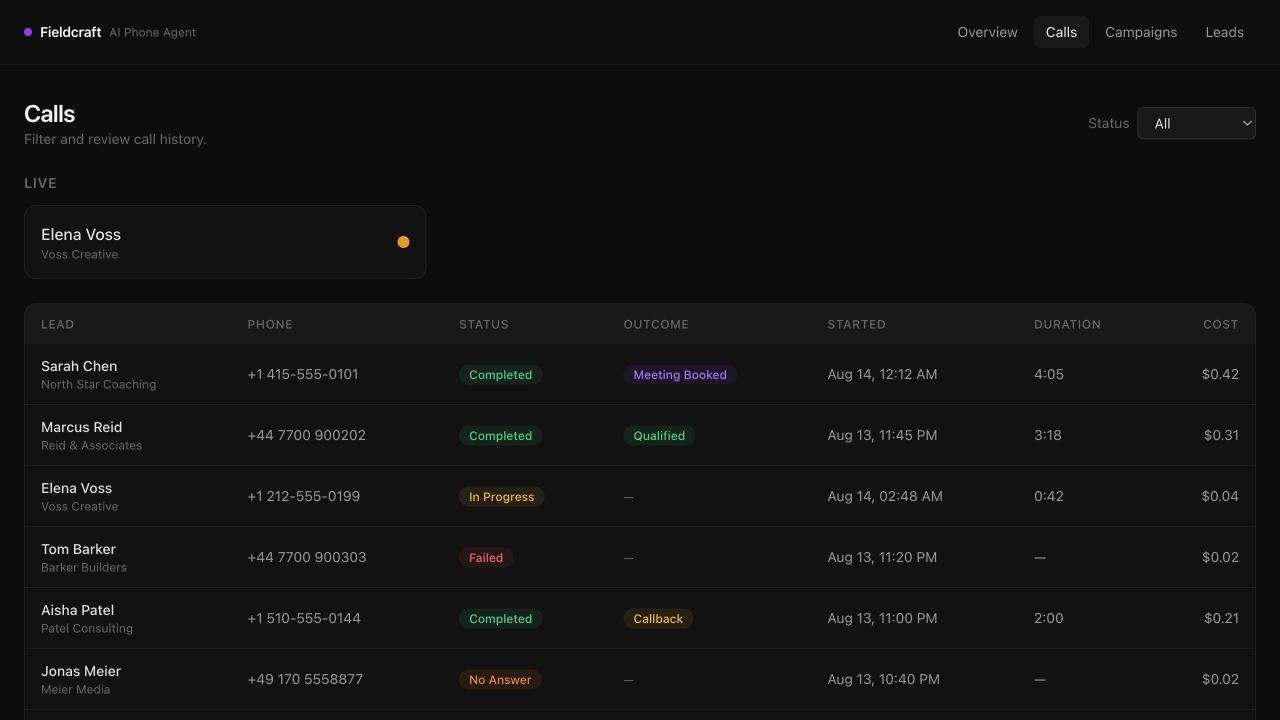
Real dashboard capture in demo mode. Every lead, number, status, outcome, duration, and cost shown is synthetic test data.Demo data
At a glance.
Operating layer
Revenue Systems
Users
Sales operator and configured phone agent
System boundary
Reference workflow and simulator
Current status
Tested reference implementation
Evidence type
Source, tests, and demo capture
The operating problem.
Lead lists, scripts, calls, qualification notes, follow-up rules, and bookings often sit in separate systems with no shared operating logic.
The operator needs to know what the agent is doing, which rule produced the outcome, what exception needs attention, and how to pause or adjust the workflow.
Before
Lists, calls, scripts, and notes in separate tools
Qualification and follow-up depend on a person reconstructing context after each conversation.
After
One configurable calling workflow with visible state
Campaigns, leads, calls, transcripts, qualification, outcomes, and exceptions share one control surface.
How the system works.
The blueprint defines the operating rules before a campaign starts.
Configure the client blueprintSet persona, offer, objections, qualification, compliance, calling rules, and provider choices.
Import or select leadsPlace synthetic demo records or approved live records into the campaign queue.
Start or pause the campaignThe operator controls campaign state from the dashboard.
Watch call stateQueued, dialing, in-progress, completed, failed, and no-answer states remain visible.
Inspect conversation and qualificationTranscript events and BANT fields are stored with the call detail.
Record the outcomeQualification, callback, meeting, voicemail, or no-answer state can drive the configured next step.
Review and adjustUse history and exceptions to change the blueprint instead of hiding logic inside prompts.
The dashboard is a control surface.
The agent sits inside an operator-owned workflow with inspectable state and explicit campaign controls.
Outbound qualification campaignDemo mode, campaign paused, no external calls
Calling rulesHours, caps, retries, consent, DNC, blocked regions
Active call workspace
Call stateIn progress, demo
Transcript eventsAgent and lead turns
QualificationBuying capacity, authority, need, timeline
OutcomeWaiting for completion
Important decisions.
Configuration over hard-coding
One per-client file holds the persona, offer, objections, qualification, campaign, compliance, and integration choices.
Demo mode uses the real state path
Synthetic events write through the database and dashboard without spending telephony or model credits.
Compliance is visible
Disclosure, recording, DNC, calling hours, blocked regions, and retention are explicit fields instead of hidden assumptions.
Provider boundaries remain replaceable
Telephony, speech, language model, CRM, and calendar choices are represented in the blueprint architecture.
Evidence gallery.
The capture documents the implemented dashboard. Synthetic outcomes are interface evidence, not commercial results.
The real calls view makes queue and outcome states visible. The selected-call drawer exists in source, but a current runtime defect prevents it from being used as public visual proof.Demo data
 Fieldcraft